
Space as a Catalyst for
Drug Development
Drug development is a long and complex process to ensure medicines are safe and effective before reaching patients. Bringing a new medicine to market is extremely expensive, risky, and slow as this entire process may take 10–15 years and requires strict scientific and regulatory evaluation.
By accelerating drug development and innovating in drug formulation and optimization, life science companies are working to deliver treatments to patients faster, improve competitiveness, and extend the effective commercial life of patented drugs. To achieve this, the industry is investing in innovative technologies to improve efficiency and reduce late-stage failures. Advanced techniques are used to help identify potential compounds or targets for treating a disease, study safety, toxicity, and effectiveness or even manufacturing the drug at the end. High-throughput screening, virtual screening, molecular modeling, and bioinformatics are used to discover potential drug candidates. New technologies like artificial intelligence (AI), machine learning, genomics, proteomics, and computational drug design are accelerating the prediction of drug behavior and improving precision. Innovative systems such as organ-on-chip models, microfluidics, and 3D cell cultures are increasingly replacing traditional testing methods to provide more accurate human-like responses. This continuous innovation is essential to improve drug safety, reduce clinical failure rates, while reducing cost and development time.
Space platforms have the potential to become a valuable part of this innovative process to support pharmaceutical and biotechnologies companies in their research and development activities. Indeed, microgravity provides a unique scientific environment where gravity-driven effects such as sedimentation and convection are minimized. Considering the full drug development process:
● During the discovery phase, microgravity supports the growth of larger and more ordered protein crystals, allowing researchers to obtain highly precise molecular structures for structure-based drug design (SBDD). This improves understanding of drug–target interactions, structural analysis and accelerates the identification of promising compounds.
● During preclinical development, microgravity enables the production of purer and more uniform crystals, improving drug stability, solubility, and bioavailability opening the door to new formulation or optimization. It also supports advanced technologies such as nanomedicine, microfluidics, and 3D tissue models, which can better simulate human biological conditions. Scientists can then study cell behavior, tissue growth, and disease mechanisms in more realistic three-dimensional systems.
● After approval, orbital biomanufacturing platforms may enable the production of complex biologics and high-value therapeutics that are difficult to produce on Earth.
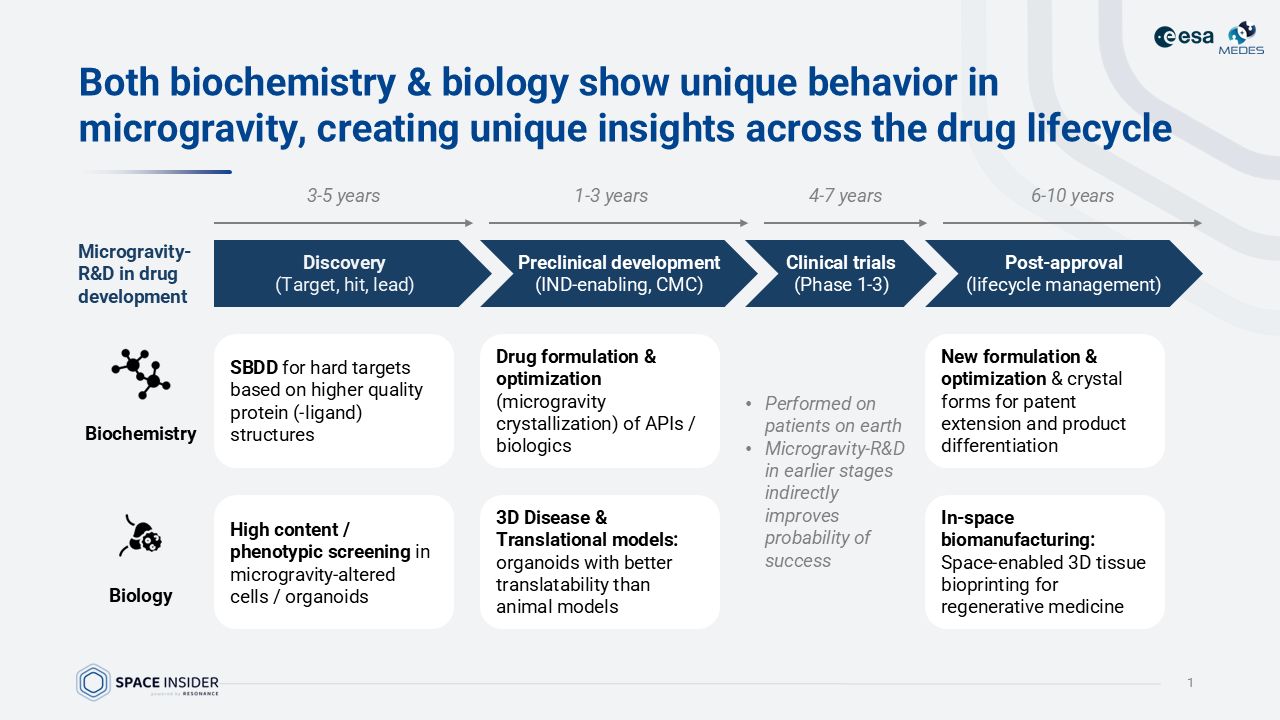
Rather than replacing existing development platforms and formulation approaches, activities performed under microgravity can complement them by providing a unique environment that can enhance crystallization processes, formulation optimization, stability studies, and advanced drug delivery strategies for both small molecules and biologics. This complementary approach positions microgravity as an additional tool to help the industry address increasing scientific, technical, and commercial challenges in modern pharmaceutical development.
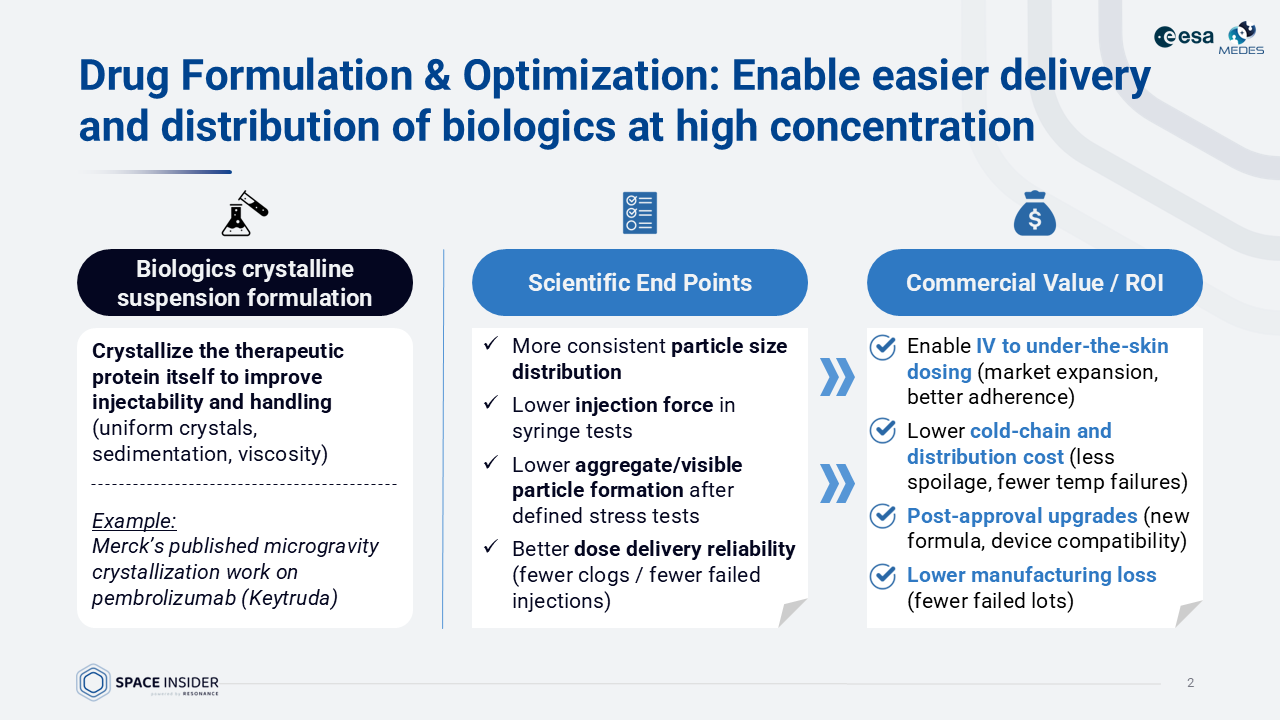
In particular, microgravity is gaining importance in drug formulation and optimization as it allows scientists to study pharmaceutical processes without the effects of gravity. A major focus is crystallization optimization because crystal form strongly affects dissolution rate, stability, manufacturability, shelf life or bioavailability. Reduced gravitational forces such as sedimentation, buoyancy, and convection allow diffusion to dominate the crystallization process, leading to the formation of purer, more uniform, and better-structured drug crystals.
● For small-molecule drugs, microgravity enables advanced solid-state crystallization and lifecycle optimization strategies. Through polymorph, salt, and co-crystal selection combined with particle engineering, scientists can identify and lock in stable, manufacturable solid forms that are suitable for toxicology supply and early formulation development. This approach improves stability, processability, and scalability while reducing formulation risks in early drug development. In addition, it supports lifecycle solid-state innovation by enabling the discovery of new solid forms and dose forms that enhance product differentiation, improve stability and bioavailability, and could extend intellectual property opportunities.
● For biologics, microgravity enables the development of advanced crystalline suspension technologies, optimizing drug stability, shelf-life, and delivery methods across the product lifecycle. By crystallizing the therapeutic protein itself, scientists create highly uniform and stable protein crystals that improve injectability, reduce viscosity, and optimize sedimentation behavior, leading to easier handling, storage, and administration of therapies. This approach supports the formulation of high-concentration biologics while maintaining product stability and performance. In addition, it enables lifecycle presentation upgrades through improved delivery formats, enhanced device compatibility, and stability optimization, helping biologic products achieve better patient convenience, extended shelf life, and stronger commercial differentiation.
The BSGN Life Sciences Industry Accelerator, operated by MEDES for the European Space Agency (ESA), is actively supporting industrial microgravity research by funding and accelerating projects across multiple stages of the drug development process demonstrating how microgravity can contribute from early discovery to translational preclinical development. The Accelerator has launched two calls for projects in 2022 and 2025 aimed at identifying and supporting commercially driven life sciences innovations that leverage the unique conditions of microgravity to address terrestrial challenges. By providing access to orbital research platforms, technical expertise, and commercial support, the accelerator enables companies to explore innovative pharmaceutical applications including disease modeling, biologics development, tissue engineering, and formulation optimization in space. This approach helps integrate microgravity into the broader pharmaceutical innovation pipeline as a complementary environment that can enhance existing drug development technologies and strategies.
Across both cohorts, projects span from early discovery and disease understanding to advanced preclinical testing and formulation innovation.
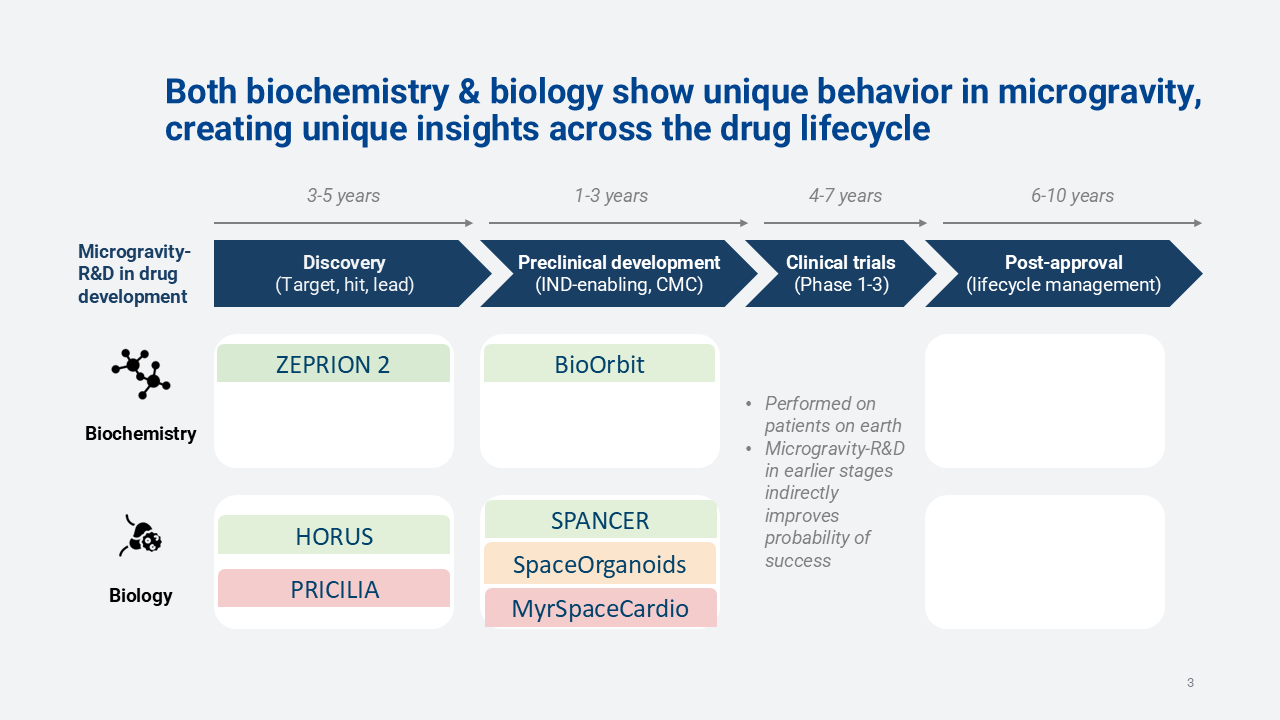
Cohort 1 projects primarily explored foundational pharmaceutical, diagnostics, and bioproduction applications in space, including protein crystallization, biologics formulation, and health technologies aimed at improving drug design and manufacturability. Cohort 2 further expanded this approach with projects such as PRICILIA, focused on disease mechanisms and therapeutic discovery for osteoarthritis, and MyrSpaceCardio, dedicated to predictive cardiac tissue platforms for preclinical drug screening and safety assessment.
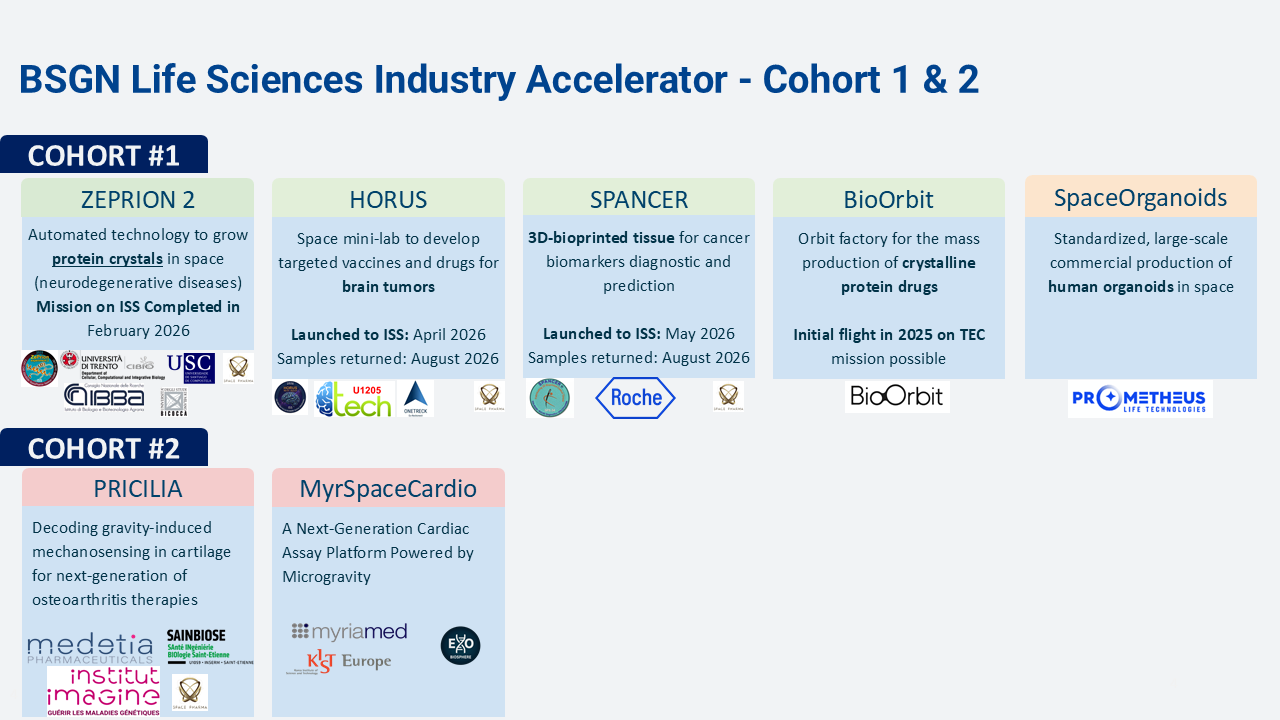
Together, these projects demonstrate how microgravity can become a complementary environment supporting pharmaceutical innovation throughout the drug development pipeline, from target identification and formulation optimization to translational preclinical research. The programme is still ongoing to engage new industrial actors and seeks to create a sustainable commercial ecosystem in space by supporting biotechnology, pharmaceutical, nutraceutical, cosmetics, and biomanufacturing projects, helping them progress from research to market-ready products while attracting private investment and reducing dependence on public funding.
● The ZePrion-2 project involves an international consortium including SpacePharma-EU, the University of Trento, the University of Milano Bicocca, the University of Santiago de Compostela, the Italian National Research Council, and the Telethon Foundation. It uses SpacePharma’s miniaturized lab-on-a-chip microfluidic platform aboard the International Space Station (ISS) to grow high-quality protein crystals in microgravity. It investigates mechanisms linked to protein folding and misfolding involved in prion diseases and other neurodegenerative disorders. The project is connected to the innovative PPI-FIT (Pharmacological Protein Inactivation by Folding Intermediate Targeting) approach, which aims to block disease-related proteins during their folding process rather than targeting the fully folded protein as in traditional pharmacology. This strategy could open new therapeutic pathways for currently difficult-to-treat diseases.
The experiment flew aboard the ISS in early 2026 and the samples are currently being analysed.
● HORUS project is involving research teams from the Université Grenoble Alpes, INSERM’s BrainTech Lab, OneTreck, SpacePharma. The project studies the impact of microgravity on human brain tumor models using advanced 3D tumoroid technologies developed in Grenoble. Its objective is to better understand how microgravity influences tumor cell behavior, gene expression, and cellular interactions in order to identify new therapeutic pathways for cancer research. The experiments launched in April 2026 and are currently performed using miniaturized microfluidic bioreactors operated aboard the International Space Station. The samples should return in August 2026.
● SPANCER project led by Roche in collaboration with Space Pharma aims to improve precision medicine in lung cancer diagnostics by developing standardized, 3D-bioprinted human tissue-mimics that express specific cancer biomarkers, such as ALK and Ros1. Current control tissues for ALK+ lung adenocarcinoma are scarce, making reliable diagnostic testing challenging and costly. The experiments launched in April 2026 and the samples should return in August 2026.
● BioOrbit‘s main objective is to use the unique conditions of space to produce highly ordered protein crystals that can improve the formulation and delivery of biologic therapies, particularly antibody-based cancer treatments. The company is developing autonomous orbital crystallization hardware platforms designed to grow therapeutic protein crystals in microgravity. Through BSGN, BioOrbit flew its first protein samples with The Exploration Company Mission Possible in June 2025. Since then, the company raised approximately £9.8 million in April 2026, and launched its Box-E crystallization unit to the International Space Station in May 2026.
● The Space Organoids project led by Prometheus Life Technologies aims to enable large-scale, commercial production of high-quality human tissues in microgravity. Production principles were demonstrated on previous ISS missions, and the project seeks now to develop an automated space production facility capable of generating standardized, scalable, and commercially viable organoids for biomedical research, drug development, and personalized medicine. The in-orbit demonstration is scheduled for 2027
● PRICILIA focuses on understanding gravity-induced mechanosensing in cartilage to support the development of next-generation osteoarthritis therapies. Its objective is to improve knowledge of disease mechanisms and identify better therapeutic strategies using microgravity models. The project was selected by the BSGN Life Sciences Industry Accelerator at the end of 2025 and is currently working on its implementation plan.
● MyrSpaceCardio develops advanced 3D cardiac tissue models and microgravity-enabled assay platforms to improve the predictive power of preclinical drug testing and drug screening. These engineered heart tissues are intended to serve as more physiologically relevant models for evaluating drug safety, efficacy, toxicity, and cardiac responses before entering clinical trials. The project was selected by the BSGN Life Sciences Industry Accelerator at the end of 2025 and is currently working on its implementation plan.