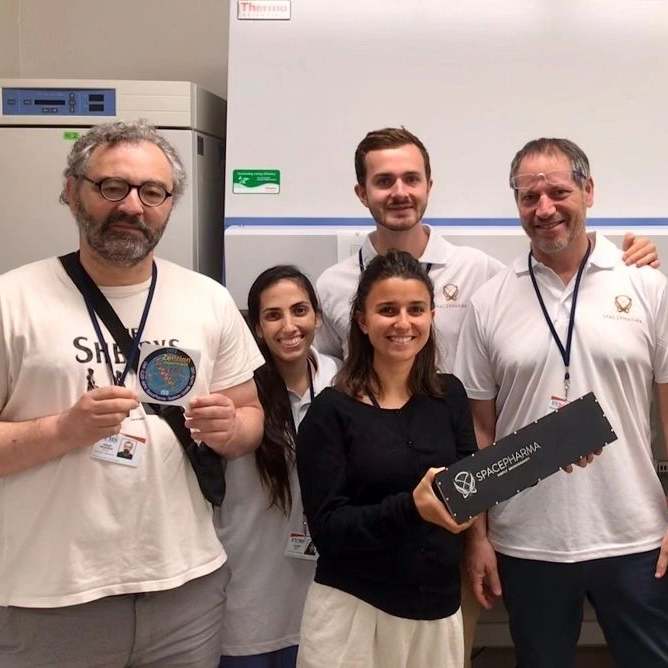
HEALTH AND LIFE SCIENCES INDUSTRY ACCELERATOR
The BSGN Life Sciences Industry Accelerator aims to engage new players from biotechnology, pharmaceuticals, and cosmetics, supporting projects that tackle terrestrial challenges through the unique advantages of the space environment combined with European commercial space-based platforms in Low Earth Orbit. It fosters collaboration with the commercial space ecosystem, encourages the development of high-potential commercial activities, and seeks to attract new sources of funding beyond ESA.

Focus Areas
Leverage the unique conditions of space to fast-track research, development, and biomanufacturing in biotechnology, pharmaceuticals, and cosmetics.
From early-stage innovation to advanced product applications, life sciences industries can harness space-based opportunities to drive breakthroughs at every stage of development.
Benefits of Microgravity for Your R&D
At reduced levels of gravity, the biological, chemical and physical processes change.
The space environment allows to re-discover materials and properties, improve understanding of processes and interaction of substances, build complex 3D materials, and to create new and more accurate data models.
You can use these insights to develop new materials and improve processes for products that can be used on Earth. Find out concrete examples on the life sciences page.
Take Your Product Development to the Next Level
- Identify the perfect research case for your project in microgravity.
- Access ESA co-funding and receive support in securing additional investment.
- Connect with the right commercial partners in the space industry.
- Refine your project with expert guidance.
- Accelerate your product’s journey from concept to reality.
What Can The Accelerator Do For You?
Drive Innovation
Provide a competitive edge in the market
Offer technical, business, and commercialisation expertise
Grant access to microgravity/space-based R&D facilities
Enable new cross-sector partnerships
Provide funding contributions and explore additional funding sources
About MEDES
MEDES is the French Institute for Space Medicine and Physiology. It was created in 1989 by the French Space Agency, CNES and Toulouse University Hospitals, its two main members. Its activities are focused on support for space missions, clinical research (with a unique research infrastructure: the space clinic) and innovations between space and health. MEDES has more than 35 years of experience for crew health maintenance for human spaceflights, operational support for research in life sciences in space, in addition to a strong expertise in clinical research and on innovation projects for health applications.
Phase One
Five projects were selected in 2023 for the first cohort of the BSGN Life Science Industry Accelerator. Each brings its contribution to the Loe Earth Orbit (LEO) value chain and potential benefit life on Earth:
HORUS (France)
Glioblastoma is one of the most aggressive and difficult-to-treat brain tumors. Current therapies have limited effectiveness, and there is a pressing need for personalized and innovative treatment approaches.
The HORUS project aims to study the impact of microgravity on glioblastoma multiforme (GBM) using an integrated set of space and AI-driven tools. It combines a tumoroid precision medicine “Earth/space cell culture box,” a digital avatar with AI-based drug repositioning, and an AI-driven image analysis platform. The project leverages microgravity to identify novel therapeutic strategies for GBM while translating findings into Earth-based applications.
This project brings together the expertise of INSERM/UGA – BrainTech Lab (project lead); CSUG – Centre Spatial Universitaire de Grenoble; OneTreck; and SpacePharma.
The Accelerator helped to develop the payload for in-space demonstrations on the ISS while guiding the life science partner through the space ecosystem and assisting in consortium building.
🗓️🚀 In-orbit Demonstration (IoD) is scheduled for Q2 2026.

Space Organoids (Switzerland)
Current organoid production on Earth is limited by gravity, reliance on artificial matrices, and scalability issues. 2D cell cultures fail to accurately mimic vivo physiology, increasing dependence on costly and ethically challenging animal experiments.
The Space Organoids project, led by Prometheus Life Technologies, aims to enable large-scale, commercial production of high-quality human tissues in microgravity. By leveraging proven organoid production principles demonstrated on previous ISS missions, the project seeks to develop an automated space production facility capable of generating standardized, scalable, and commercially viable organoids for biomedical research, drug development, and personalized medicine.
This approach accelerates pharmaceutical development, reduces costs, improves logistics, and provides standardized high-quality human tissue for research and precision medicine.
The accelerator provided comprehensive support, combining co‑funding and financial backing with guidance on technical feasibility and the operational challenges of conducting experiments in space.
🗓️🚀 In-orbit Demonstration (IoD) is scheduled for 2027.

BioOrbit (UK)
Many protein-based therapeutics, particularly monoclonal antibodies used in oncology and autoimmune diseases, are currently administered via lengthy IV infusions in hospital settings. This practice reduces patient comfort, increases hospital and clinical costs, limits access of patients in remote or lower-resource environments, and adds logistic constraints in healthcare delivery. On Earth, the crystallisation of large and complex proteins such as mAbs is technically difficult, preventing widespread adoption of crystalline formulations that would allow faster, self-administered injections.
BioOrbit aims to develop an orbital pharmaceutical manufacturing platform dedicated to the large-scale production of crystalline protein therapeutics, with an initial focus on monoclonal antibodies (mAbs). By leveraging microgravity conditions, the system will produce highly homogeneous protein crystals suitable for subcutaneous (SC) injection, enabling a shift away from hospital-based intravenous (IV) administration.
The accelerator support included co-funding flight of protein samples with The Exploration Company Mission Possible enabling the first spaceflight of the company.
BioOrbit represents a transformative opportunity to integrate space manufacturing into the pharmaceutical value chain. By enabling more comfortable and accessible biologic therapies, the project has the potential to improve patient outcomes globally while opening a new commercial sector in orbital biomanufacturing. It demonstrates how space infrastructure can directly benefit human health on Earth, creating both societal and economic value.
Learn more about BioOrbit here.

SPANCER (Switzerland)
This project addresses the critical shortage of reliable control tissues for rare lung cancer biomarkers, which are essential for accurate diagnostics and personalized treatment. Patient-derived tissues vary in cellularity, architecture, and biomarker expression, and they are often exhausted quickly. This variability can lead to inaccurate results, affecting diagnosis, prognostics, and targeted therapy decisions in cancer care. Current control tissues for ALK+ lung adenocarcinoma are scarce, making reliable diagnostic testing challenging and costly.
The SPANCER project aims to improve precision medicine in lung cancer diagnostics by developing standardized, 3D-bioprinted human tissue-mimics that express specific cancer biomarkers, such as ALK and Ros1. The project proposes creating reproducible 3D-bioprinted lung cancer tissue-mimics incorporating malignant, endothelial, and fibroblast cells in a scaffold that replicates lung tissue architecture. These tissue-mimics will be validated with standard staining protocols to ensure accurate biomarker expression and morphology. Once validated, these tissue-mimics will be widely available to anatomical pathology and reference labs, supporting diagnostic, prognostic, and predictive assays. They provide a stable, reproducible alternative to rare patient-derived tissues, improving the reliability of precision medicine on Earth.
Microgravity experiments aboard the ISS can enhance tissue quality and biomarker expression, enabling the production of more consistent and physiologically relevant tissue-mimics. This may improve our understanding of cancer biomarker behavior and tissue maturation in ways that are not possible on Earth.
The accelerator support on this project included co-funding & financial support of 3D-bioprinted lung cancer tissue-mimics, helping SPANCER move from concept to launch. In addition, through the accelerator and the BSGN, the project team received support on technical feasibility and operational challenges in performing experiments in space, and ensuring that the mission can leverage in-orbit platforms (such as the ISS) to perform the experiment.
🗓️🚀 In-orbit Demonstration (IoD) is scheduled for Q2 2026.
Zeprion2
In modern drug discovery, a large fraction of potential pharmacological protein targets are considered “undruggable”. These are proteins whose native conformations present no obvious binding pockets for small-molecule drugs. Yet, proteins are dynamic: they adopt many conformations, including non-native (or transient) states.
In space, the absence of convection and sedimentation makes protein crystallization much more favourable. Crystals grown in microgravity can be far more ordered and of higher quality than those grown on Earth. This improved crystallinity can yield superior structural data, especially crucial for unstable or aggregation-prone proteins like non-native conformers.
ZEPRION II harnesses this benefit by using a microfluidic lab-on-a-chip device, developed by SpacePharma-EU, which is operated remotely aboard the International Space Station (ISS). This setup enables controlled initiation and monitoring of crystal growth under microgravity, which can unveil binding poses that would be very difficult (or impossible) to resolve on Earth.
The accelerator co-funded development of the microfluidic crystallization system, and the space related cost, helping ZEPRION II move from concept to launch.
Through BSGN, the project team receives support on technical feasibility and operational challenges in performing experiments in space and it ensures that the mission can leverage in-orbit platforms (such as the ISS) to perform the experiment.
To read more about ZEPRION2 launch, click here.
🆗🚀 In-orbit Demonstration (IoD) was launched in August 2025.