
Space as a Catalyst for
Agri-food innovation
Europe’s agri-food industry offers major opportunities for innovation. Where can microgravity help companies improve crops, ingredients and food processing, and what evidence would justify investment?
The EU food and drink industry generates around €1.5 trillion in annual turnover, employs 4.8 million people and includes approximately 310,000 enterprises, according to FoodDrinkEurope. Growers, ingredient producers and food manufacturers need to improve crop resilience, manufacture new ingredients efficiently and reduce losses along the food chain. Eurostat reports 57.9 million tonnes of food waste in the EU in 2024, including edible and inedible parts.
The European Space Agency (ESA) runs the Business in Space Growth Network (BSGN) Agri-Food Industry Accelerator, which connects these industrial needs with feasible space experiments designed to generate useful evidence for innovation on Earth.
Why microgravity matters for agri-food research

Credits: ESA/NASA
Microgravity is the near-weightless environment experienced in orbit. It reduces sedimentation and buoyancy-driven convection, changing how cells, nutrients and fluids interact. Plants develop without their usual gravitational cues, while microorganisms may change their metabolism, gene expression and biofilms formation. Biofilms are communities of microbes that attach to surfaces. Spaceflight also involves radiation and hardware-related effects. Suitable flight and ground controls are therefore essential to separate these influences before attributing a response to microgravity.
For an industrial team, a useful outcome is a strain to optimise, a crop trait to validate, a preservation process to improve or a material property to control. Teams should compare results with a terrestrial baseline and then tested under the intended industrial conditions.
A market assessment by STAM and SCM Europe compared six areas: industrial needs, European policy relevance, market size, investment potential, the European stakeholder ecosystem and available commercial space facilities.
Plant biology emerged as the strongest near-term opportunity, scoring 57/60. Microbial biomanufacturing and precision fermentation, synthetic biology and bioprocessing followed closely, each scoring 55/60. These fields combine established industrial ecosystems with existing flight capabilities. This gives companies a practical basis for assessing how microgravity could support research and product development.
Food preservation and safety also offer near-term potential, with a score of 51/60. Opportunities in novel bio-based materials (49/60) and cellular agriculture (43/60) are likely to take longer to develop because the specialised technologies and industrial support they need are still maturing.
The assessment considered commercial and investment potential alongside industrial needs, European policy priorities and the readiness of the industrial and space ecosystems. The scores support comparisons for outreach and project development; they do not predict success.
The market figures refer to terrestrial industries. The assessment does not quantify the serviceable market for paid microgravity research and development.
Where the business opportunities lie
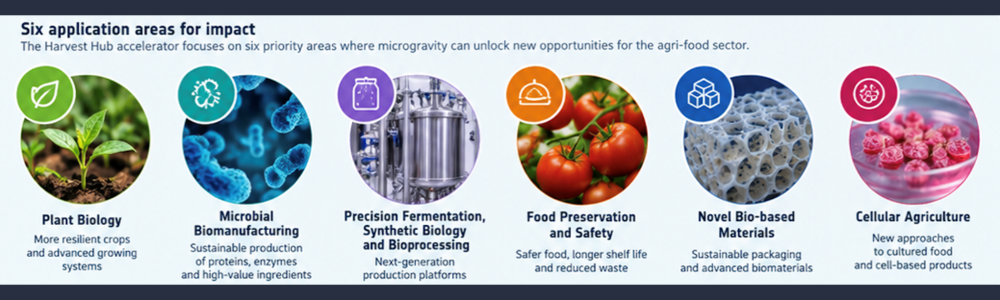
Plant biology and resilient crops
Seed companies, agricultural biotechnology businesses and controlled-environment growers need crops that maintain performance with less water and more efficient nutrient use. Microgravity research can investigate root development, nutrient transport and the signalling pathways involved in plant stress responses. Findings could guide breeding or the development of biological crop inputs. Their value would be measured by subsequent improvements in crop performance on Earth.
In a 2024 briefing to the EU Fertilisers Market Observatory, the European Biostimulants Industry Council presented an estimate that puts European plant biostimulant sales at about US$1 billion in 2023 and projected them to reach about US$1.5 billion by 2027, measured at manufacturer prices. Relevant commercial outcomes include microbial formulations or breeding targets that can be tested for nutrient-use efficiency and yield stability under stress.
Corporate interest is already visible: the Target-sponsored ISS Cotton Sustainability Challenge selected three projects in 2018, including root-development and crop-genetics studies targeting water efficiency and stress resilience. Although focused on a fibre crop, it illustrates how commercial supply-chain needs can shape space-enabled agricultural research.
Microbial biomanufacturing and precision fermentation
Microbial biomanufacturing uses microorganisms to make products such as protein ingredients, enzymes and vitamins. Precision fermentation targets specific molecules, often using engineered strains. For ingredient producers and biotechnology companies, commercial success depends on reliable yields, consistent quality and competitive production costs.
Experiments in microgravity can examine microbial metabolism, stress responses and the movement of nutrients and gases around cells. The evidence may help teams identify targets for strain improvement or refine bioprocess models. Any resulting change in performance must then be assessed in terrestrial fermentation systems, including at pilot scale. NASA’s BioNutrients-1, launched in 2019, has already tested engineered yeast for on-demand nutrient production aboard the ISS.
The Good Food Institute reports more than 163 specialised companies active in fermentation-derived proteins and ingredients in 2025, with US$357 million raised that year. For ingredient producers, the commercial opportunity is to select strains and culture conditions for terrestrial development, targeting protein yield, ingredient functionality and cost per kilogram.
Food preservation and safety
Contamination, spoilage and biofilms cause product losses and limit shelf life. Food manufacturers and preservation technology developers can use microgravity experiments to investigate how microorganisms adapt and form biofilms under altered transport conditions. A better understanding of these responses could inform contamination controls, preservation strategies and predictive models. Teams would then test their effectiveness in the intended food or processing environment. CNES’s MATISS experiments have tested advanced surfaces against glass controls aboard the ISS, providing a flight precedent for contamination-control research.
The European Commission estimates the annual market value of EU food waste at €132 billion. Better preservation could help address part of this challenge: validated improvements in shelf life or contamination control could help processors and packaging developers reduce rejected batches and contamination-related losses.
Bio-based materials and sustainable packaging
Packaging developers need renewable materials that meet practical performance and cost requirements. Research on microbial polymer production and biological self-assembly in microgravity could reveal how material structure and properties develop. Relevant applications include coatings, packaging and materials made from agricultural by-products. This is a strategic growth area in the assessment, with less mature specialist space capabilities than the leading biological applications. NASA’s Mycotecture project has fabricated fungal-biocomposite prototypes and tested materials in a planetary simulator on Earth. This is a related materials precedent, but microgravity-enabled food-packaging applications still need dedicated research and validation.
Cellular agriculture
Cultivated meat and seafood developers face challenges in tissue structure and production at scale. Reduced sedimentation offers a setting for studying how cells aggregate and organise into three-dimensional structures, including approaches without supporting scaffolds. The assessment treats this as an emerging opportunity: promising biological questions remain, but its commercial ecosystem and dedicated space facilities are less developed than those of the leading application areas. An early proof of concept came in 2019, when Aleph Farms and 3D Bioprinting Solutions assembled cultivated meat tissue aboard the ISS. This demonstrated tissue assembly; commercial-scale production remains a separate challenge.
Early BSGN projects show a route to orbit
Two companies supported by the first BSGN Agri-Food cohort have taken industrial research questions to the International Space Station (ISS).
Astrobiome, based in Luxembourg, is developing microbiome-based solutions for agriculture. Its experiment, launched in September 2025 with Yuri’s ScienceTaxi BioSpin facility, investigates how space conditions affect its microbial biostimulant solution. The commercial objective is to inform the development of biological products that support crop performance. Post-flight findings could help prioritise microbial formulations for terrestrial crop trials and subsequent product development.
Astrobiome has also reported a partnership with Bonneval on Joséphine Postbiotique, a sparkling postbiotic drink available at Auchan in France. The beverage provides a separate commercial outlet for its ingredients alongside its agricultural R&D.

Sophie’s BioNutrients, based in the Netherlands, develops protein ingredients from microalgae. Its SOPHONSTER experiment flew to the ISS in April 2025 to investigate whether microgravity affects microalgae growth and protein yield. Samples returned to Earth for analysis.
The research aims to inform production methods for sustainable food ingredients, including alternatives to dairy and meat. For ingredient producers, the intended value is higher protein productivity or improved ingredient functionality, subject to validation in terrestrial cultivation.

Turning flight data into commercial value
A commercially credible microgravity project starts with a development decision: investing in a strain, validating a crop trait or changing a preservation technology. Flight data should inform that decision. A strong proposal explains:
- the terrestrial bottleneck and its economic significance;
- what microgravity can reveal beyond the available terrestrial tools;
- the experiment, appropriate flight and ground controls, and measurable outputs;
- the ground-validation work and commercial decision that follow the flight.
A strong business case identifies who will use and pay for the result: a seed company, ingredient manufacturer, fermentation specialist, packaging producer or food processor. It explains why the expected value of the information justifies a flight experiment. Where possible, it defines the relevant metric: yield per hectare, productivity per liter, cost per kilogram, reduction in contamination or extension of shelf life. Researchers contribute experimental expertise; industrial partners provide product requirements, validation facilities and a route to adoption. Commercial value may also come from differentiated ingredients or protectable process knowledge.
Projects can create opportunities for commercial space service providers supplying experiment hardware, cultivation systems and analytical services. Investors can assess follow-on development against measurable performance targets, industrial-partner engagement and a credible validation plan.
Explore BSGN opportunities
Managed by STAM in partnership with SCM Europe, the ESA BSGN Agri-Food Industry Accelerator helps companies build a business case, design microgravity experiments and connect with commercial space service providers. Support includes guidance on ESA funding opportunities and additional investment.
Strong projects may start with a practical question from an industrial biotechnology or precision fermentation company, a seed or agricultural biotechnology business, or a food and beverage manufacturer. These companies can work with research partners and commercial space service providers.
The BSGN welcomes projects in all six application areas and cross-cutting proposals on crop resilience, water and nutrient use, sustainable manufacturing, circular systems and future food technologies.
Applicants should explain the market need, the specific reason for using microgravity and the intended path to industrial validation. Proposals can be submitted through ESA’s Open Space Innovation Platform (OSIP) until 15 January 2027.
If you would like to know more, please register for the Webinar on the 23 Nov 2026 at 16:00 CET.
Read the Call and apply on OSIP
For an initial discussion, e-mail: bsgn.agrifood@stamtech.com