Innovate beyond Earth - Meet the Second Cohort of ESA's Life Science Accelerator
Share this page
Following the 2nd Call of the BSGN Life Science Industry Accelerator in April 2025, one ground-breaking project has been selected for acceleration and deployment in orbit: MyrSpaceCardio.
Selected from a competitive pool of 22 applications across 12 ESA Member States, this project aim to develop commercial solutions for Earth by boosting their R&D through the unique properties of the space environment. During the Acceleration phase, The Business in Space Growth Network (BSGN) ,an ESA’s initiative designed to drive the growth of new economic markets in Low Earth Orbit and on the Moon, in collaboration with the Life Science Accelerator managing partner, MEDES (Institute for Space Medicine and Physiology), will support the consortiums of this second cohort in refining technical and commercial plans, preparing the selected project for implementation and deployment in orbit.
About MyrSpaceCardio
A Next-Generation Cardiac Assay Platform Powered by Microgravity
Lead Entity: Myriamed (SME, Germany)
Consortium Partners: KIST Europe (Germany), Exobiosphere (Luxembourg)
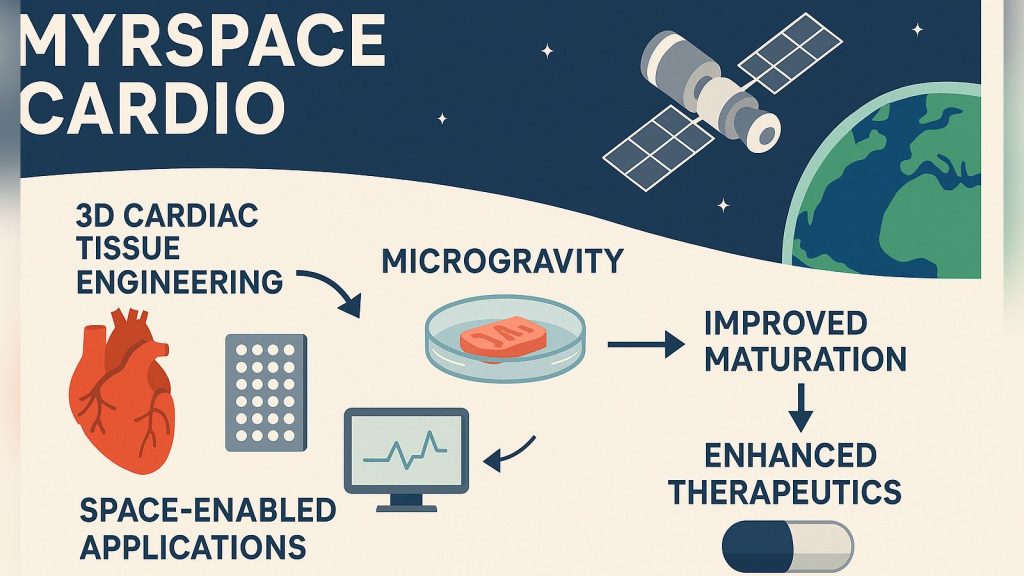
MyrSpaceCardio aims to adapt myriamed’s engineered heart muscle screening platforms into a high-throughput system optimized for microgravity. By performing tissue-engineering experiments in space, the project enhances the physiological relevance of lab-grown cardiac tissues and brings them closer to true human biology. Removing gravitational constraints is expected to promote more robust tissue assembly, advanced metabolic maturation, and improved functional performance, which will be assessed through in-flight imaging and post-flight multi-omics analyses. This mission will validate the first scalable, space-enabled cardiac tissue screening platform, generating models that more faithfully reflect human cardiac responses and enabling advanced drug development, in-orbit screening, and personalized space medicine.



What comes next?
Throughout the acceleration journey, the selected project’s lead will benefit from a dedicated 1-to-1 relationship with MEDES, gaining access to tailored support across all stages – from business maturation to the design of spaceflight experiments. This ensures both technical and commercial readiness for their missions.
Key advantages for the selected project include:
- • Expert guidance in navigating the complex space ecosystem, fostering connections with key stakeholders and resources.
- • Assistance to refine private funding strategy beyond ESA support, while project leads retain final responsibility.
- • Hands-on support in preparing documentation for ESA’s co-funding tools, simplifying the application process.
- • Enhanced visibility and promotional support to amplify project exposure within the space and life sciences industries.
This initiative underscores the commitment of the BSGN Industry Accelerator to propel innovation in life sciences, fostering collaboration and accelerating the journey from concept to orbit.
More information
About MEDES
MEDES is the French Institute for Space Medicine and Physiology. It was created in 1989 by the French Space Agency, CNES and Toulouse University Hospitals. Its activities are focused on support for space missions, clinical research (with a unique research infrastructure: the space clinic) and innovations between space and health. MEDES has more than 35 years of experience for crew health maintenance for human spaceflights, operational support for research in life sciences in space, in addition to a strong expertise in clinical research and on innovative projects for health applications.
About ESA
The European Space Agency (ESA) provides Europe’s gateway to space. ESA is an intergovernmental organisation, created in 1975, with the mission to shape the development of Europe’s space capability and ensure that investment in space delivers benefits to the citizens of Europe and the world. By coordinating the financial and intellectual resources of its members, ESA can undertake programmes and activities far beyond the scope of any single European country. It is working in particular with the EU on implementing the Galileo and Copernicus programmes as well as with Eumetsat for the development of meteorological missions.
About BSGN Life Science Industry Accelerator
The BSGN Industry Accelerators are part of an ESA initiative designed to drive the growth of new economic markets in Low Earth Orbit and on the Moon. These accelerators facilitate collaboration with key industry players, attract new market entrants, and support the development of commercially viable business models based on space research. Operating under a public-private co-funding model, the BSGN Life Science Industry Accelerator is managed by ESA’s Industrial Partner MEDES. It focuses on leveraging microgravity for cutting-edge research in biotechnologies, pharmaceuticals and cosmetics, helping companies find the right partners and funding tools to turn their innovations into reality.
Related News

hero
Agri-food
The 2nd Call of the BSGN Agri-food Industry Accelerator is now open
02/September/2026