In March 2025, ESA launched an OSIP call to support three co-sponsored research projects focused on the business and financial modelling of the space resources value chain.
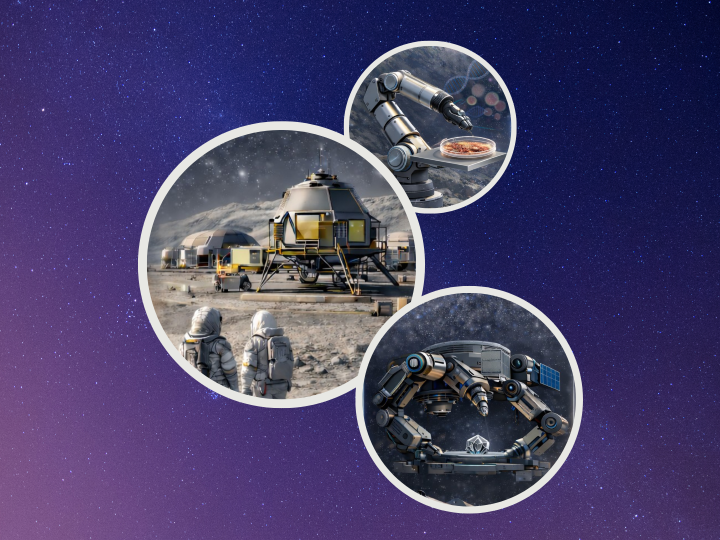
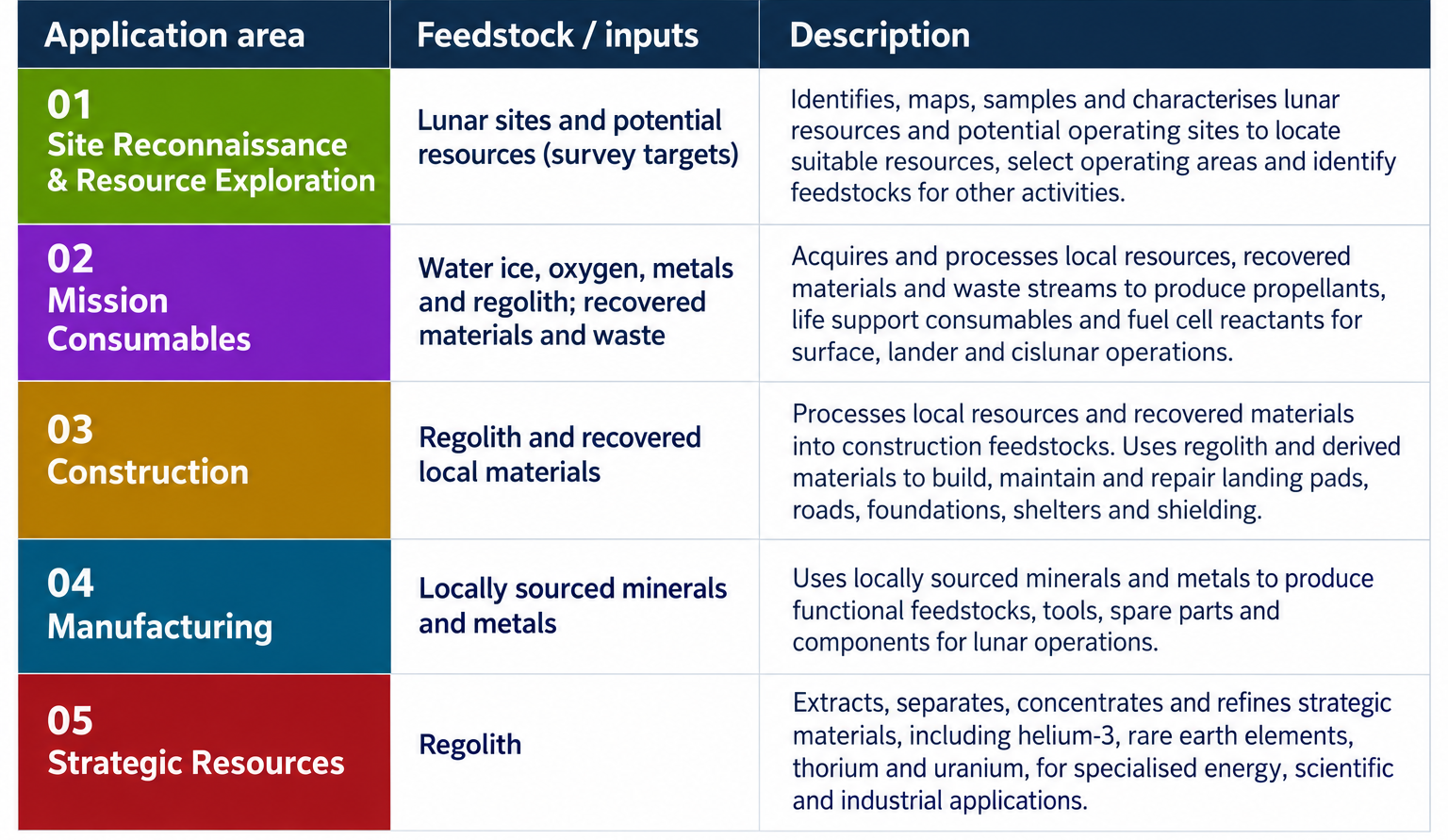
As lunar exploration plans advance, agencies and companies are exploring how resources available on the Moon could support future missions. This approach, known as in-situ resource utilisation (ISRU), could enable applications such as construction, refuelling, life support, in-space manufacturing and the production of key resources.
However, the commercial viability of ISRU remains uncertain. To better understand its market potential, ESA plans to develop financial and business modelling tools that can support simulations, forecasts, strategic planning, risk management and decision-making for future space resources projects.
The selected teams, presented below, will explore different applications of the space resources, developing a business model for the lunar space resources value chain. Each project will contribute to a clearer understanding of the commercial viability, sustainability and potential profitability of ISRU activities.
Together, the projects will help build a clearer picture of how a future space resources market could develop, giving space agencies, companies and entrepreneurs a stronger basis for identifying opportunities for investment, collaboration and future activities.
Turning uncertainty into opportunity
ESA sees space resources as a strategic opportunity for the future lunar economy and is taking an active role in helping explore how such a market could develop. Through these co-sponsored research projects, ESA aims to support the transition from early ISRU concepts towards service-oriented approaches, in which future capabilities can be developed, delivered and used by space agencies, companies and other organisations. By involving companies and potential future economic operators, the projects can help shape ISRU capabilities around real use cases, viable services and future market demand.
This clearer understanding of the potential market can also inform the ESA BSGN ecosystem. As opportunities become easier to identify, existing companies — including those not traditionally active in the space sector — may see how their expertise in areas such as construction, manufacturing, logistics, energy, materials or digital services could contribute to the lunar economy.
The BSGN Accelerators can help bring relevant actors together and support companies as they explore how their capabilities can contribute to emerging space resources value chains.
The selected teams
The Imperial College London is led by Michel-Alexandre Cardin, Associate Professor in Engineering Systems Design and Director of the Strategic Engineering Laboratory at Imperial College London. Their approach looks for quantitative ways to design and invest in complex systems when the future is uncertain i.e., how to use system concepts like flexibility, theories like real options analysis, and decision-support tools to enable better investment decisions under uncertainty.
The chosen ISRU macro-application for this project is construction and manufacturing.
The methodology of the project intends to bring that strategic-engineering perspective to the economics of ISRU: rather than relying on one forecast of the lunar economy, they are developing ways to compare alternative value-chain architectures, risks, and stakeholder perspectives, and to make better staged decisions as new information becomes available.
The University of Luxembourg team is led by Prof. Dr. Hein, Associate Professor at SnT and head of the SpaSys research group. He mainly works on disruptive space system design and engineering. He has a strong expertise in systems engineering approaches applied to space systems and has previously published on the techno-economic analysis of ISRU.
Their chosen macro-application is propellant.
Their general approach to reach the main technical objectives is the use of a combination of techniques from the field of systems architecting (how to conceive complex systems at the early stages), trade-space exploration (generate and explore a large number of system alternatives), techno-economic and sustainability analysis (analyse the impact of technological choices on economics and sustainability).
The user will be able to evaluate and compare different value chain architectures based on multiple performance metrics. The process begins with user inputs (such as stakeholder positioning and market assumptions) and variables, including technology availability and deployment sequences. These inputs are then used to automatically generate and evaluate various value chain architectures, possibly with further interactions with the user.
The MIRORES Mining Data Service team, a research-focused Polish company specializing in the exploration of Earth and space resources is led by Dr. Jakub Ciążela.
Their chosen macro-application is strategic resources, and in particular helium-3.
Their approach foresees the development of AI-based platform which put together an LLM, Financial Modeling Tool and Lunar Data. The tool will be able to execute advanced simulations, automating the execution of Monte Carlo simulations and multi-variable sensitivity analyses. This provides a stochastic evaluation of risk, allowing users to quantify the impact of technical and market uncertainties such as hardware failure rates or fluctuating launch costs on Net Present Value (NPV) and Internal Rate of Return (IRR).
Capital and operating costs will be integrated to calculate the break-even mass of marketable helium-3 that must be returned to Earth. The analysis will remain open to comparison with other candidate resources, including REEs and PGMs.
Interested companies, researchers and organisations are invited to follow the progress of these projects and explore how their expertise could contribute to future space resources value chains.
For questions or to learn more about ESA BSGN activities in this area, contact bsgn@esa.int